

Dry cut vs wet cut for curly hair in St. Louis
You're sitting in the chair. Your stylist asks if you want your curls cut wet or dry. You've heard both methods mentioned, but you're not sure what the difference means for your hair. The method matters because curly hair behaves completely differently wet than dry, and the wrong approach can leave you with a shape that doesn't match what you saw in the mirror at the salon.
Dry cutting shows each curl where it naturally falls
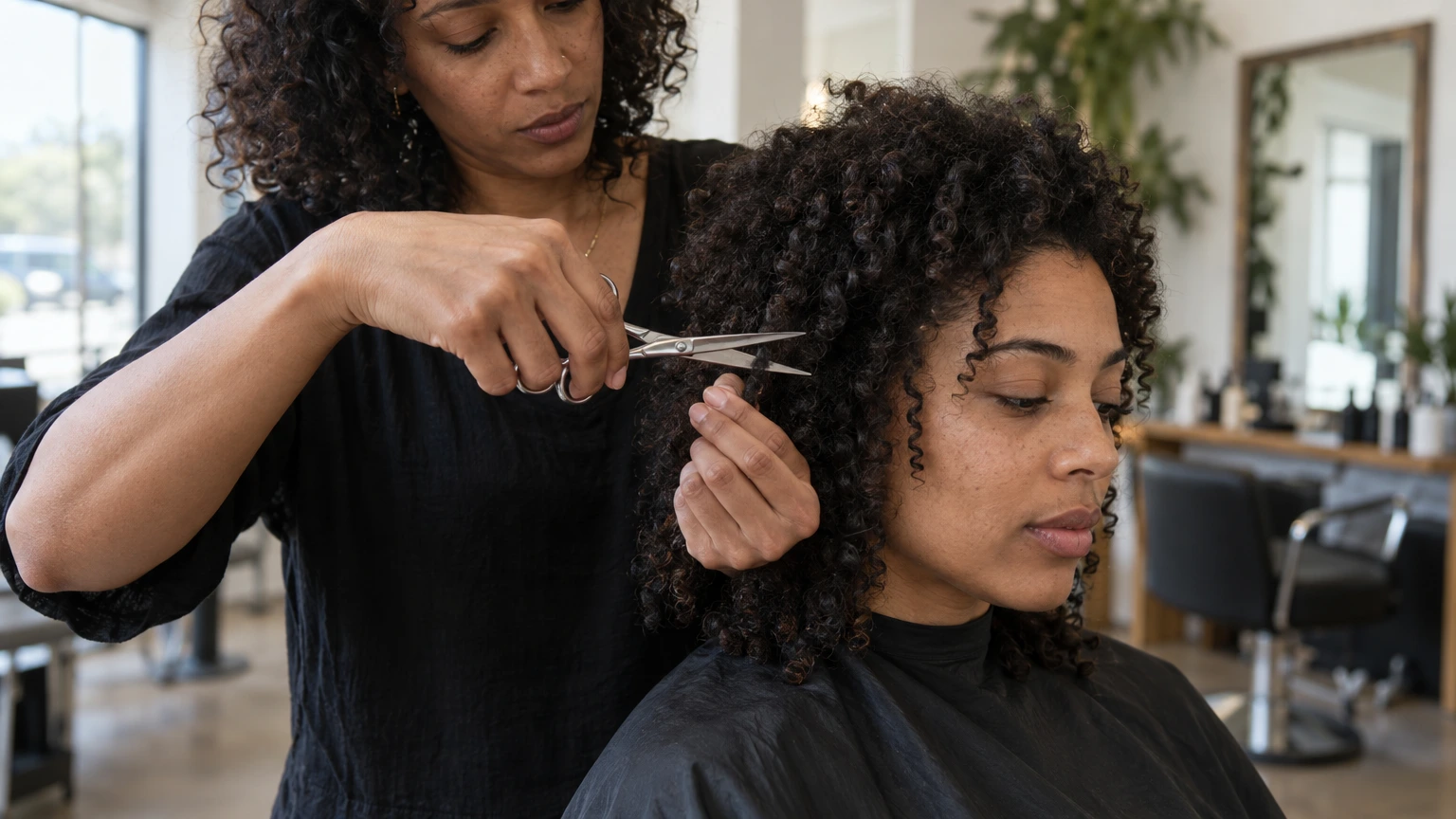
Dry cutting means your stylist shapes your curls after they're washed, dried, and sitting in their natural pattern. The stylist works curl-by-curl on dry hair to see exactly how each one falls and behaves, which eliminates the guesswork that comes with shrinkage. The stylist sees the exact length in real time with no hidden stretch and no guessing, so each curl sits where it will sit tomorrow.
For curly hair, dry cutting can be a game-changer because curly hair tends to shrink and change shape when wet, making it difficult to determine the final length and shape of the cut, and by cutting the hair while it's dry, the stylist can work with the natural curl pattern. In St. Louis, where humidity shifts with the seasons, this approach gives you a cut that holds its shape whether you're walking through Forest Park in July or navigating a February freeze.
Methods like Curly Hair Artistry train stylists to read your texture curl by curl. Each section gets individual attention. The result is a cut that works with your natural spring, not against it.
Wet cutting creates uniform length but hides your curl pattern
Wet cutting is the traditional salon method. Wet haircuts allow for faster, cleaner sectioning and more uniform lengths across the entire head, and the hair is easier to comb through. Wet cutting simplifies the detangling process because when hair is wet, the natural oils and moisture help to loosen knots and reduce friction between strands.
The downside? Wet hair temporarily hides natural curl patterns, waves, and volume, and when that hair dries, it can shrink significantly, with the amount varying by curl pattern. If your stylist cuts your curls at wet length without accounting for spring, you can leave the salon and realize your hair is much shorter than you expected once it dries.
The triangle shape happens when the crown of the head sits close but the ends of the curls sit wide, and it is a classic side effect of wet cutting on curly hair because the stylist cannot see the crown volume. Wet cutting can work for drastic changes or layering, but it requires experience with curly hair shrinkage to avoid surprises.
Which method works best depends on your curl pattern and goals
Wavy hair often benefits from wet cutting, while coily hair often needs dry cutting to avoid shrinkage surprises.
If you wear your curls naturally most of the time and want a shape that mirrors how your hair moves at home, dry cutting is the better fit. Curly clients almost always benefit from a dry cut because the stylist reads each curl one by one, respects the spring factor, and shapes without shrinkage surprises. If you're making a big change or want a uniform baseline, wet cutting can establish structure, but the shape needs to be refined dry to match your curl behavior.
Many curly hair specialists in St. Louis use a hybrid approach. At some salons, stylists use a custom approach where they start cutting dry to map your curl's overall shape and see where the weight falls, then switch to wet cutting to add volume with inside layering, and after styling and drying your stylist will make final edits. That combination gives you the precision of wet cutting with the accuracy of dry finishing.
At Curls Done Wright, Lily offers dry curly haircuts and has trained in curly hair artistry. Arrive with your hair fully dry and styled as usual so Lily can see how your curls behave, including their shrinkage, before she shapes them.
Shrinkage is the reason dry cutting matters for tight curls
Tight coils can look much shorter dry than wet, so Lily assesses their dry shape before deciding how much length to remove.
Shrinkage varies between people and across different patterns on the same head. Seeing your usual dry style helps Lily discuss the length you want to keep and the shape you want from your cut.
If your curls tighten when humidity rises or loosen in dry winter air, a dry cut accounts for that. The stylist sees your curl in the environment it lives in and cuts accordingly. Wet cutting can't offer that.
What to expect during a dry curly haircut
For a curly cut at Curls Done Wright, arrive with your hair fully dry and styled as usual. Lily wants to see how your curls behave in their everyday style so she can assess their shape and shrinkage before cutting. Lily assesses your curl pattern, notes where volume sits, and discusses your goals before cutting.
The cutting happens curl by curl. Each curl has its own pattern and tightness, and your stylist evaluates these qualities individually and sculpts sections to follow your hair's natural texture. The process takes longer than a wet cut because each section is treated individually, but the result is a shape that mirrors your daily texture. After the cut, you'll receive a styling session that shows you how to replicate the look at home.
How to style curly hair at home between salon visits breaks down the techniques that keep your cut looking sharp between appointments. The goal is a cut that reduces your styling time, not one that requires an hour of work every morning.
Dry cutting works best when you wear your curls natural
Dry cutting delivers the best results for curls you wear natural most of the time, not for hair you straighten regularly.
The method is built for people who want to work with their texture, not fight it. If that describes you, dry cutting gives you a shape that enhances your curl pattern instead of hiding it. If you're tired of the triangle shape, the uneven layers, or the surprise inches missing after wash day, dry cutting solves those problems.
At Curls Done Wright, the focus is education. You learn why your curls behave the way they do and how to care for them between visits. 7 things every curly-haired person should know after their cut covers the maintenance that keeps your shape intact as it grows out.
Ready to see what your curls can do?
If your curls have been cut wet your whole life and you're not sure what they're capable of, a dry cut changes that. You'll see your curl pattern honored, your shrinkage accounted for, and your shape designed around how your hair moves in St. Louis weather. Book a curly haircut and bring your curls as they are.