

Best curly hair cutting method for your texture in St. Louis
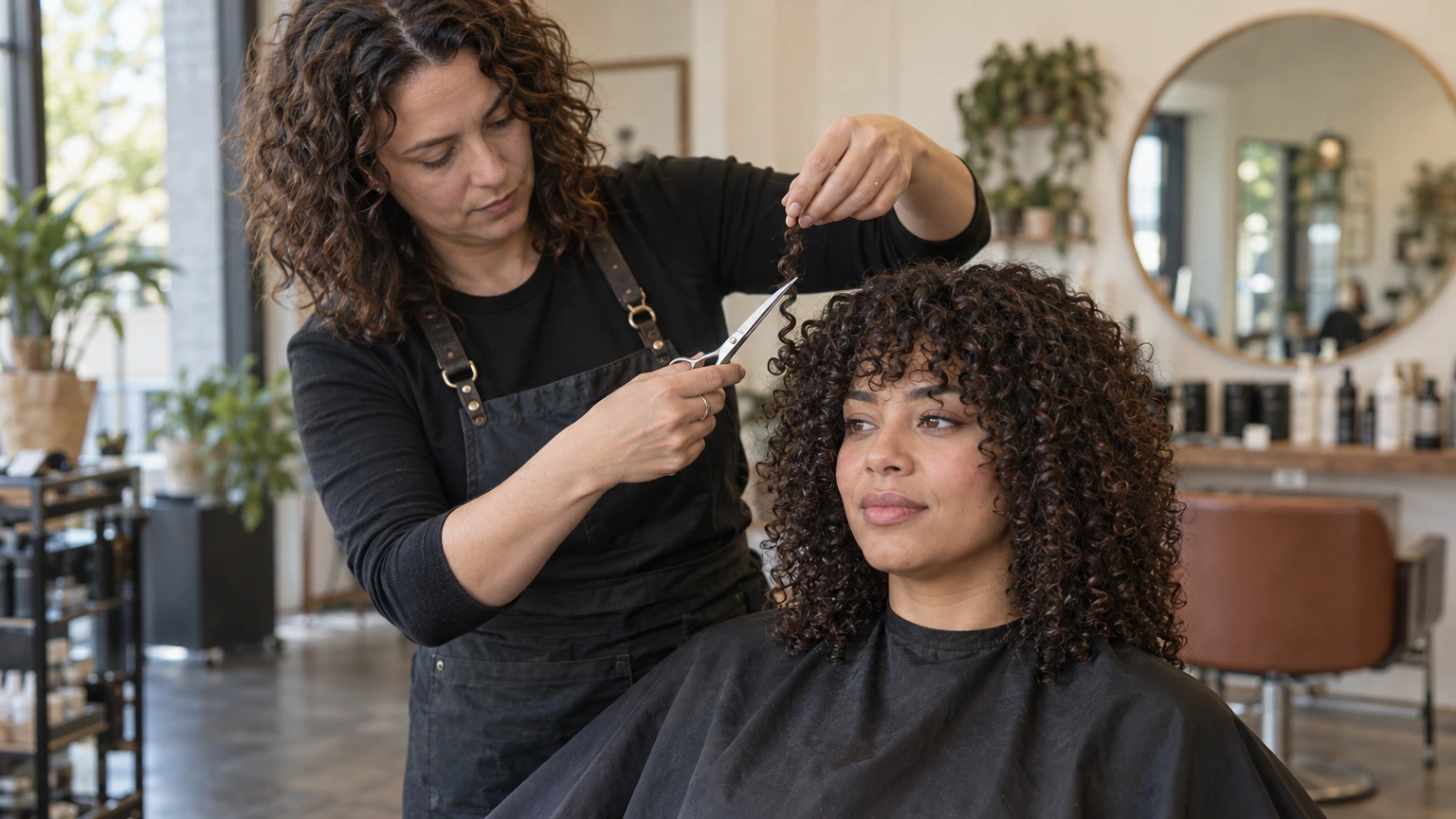
You've seen the terms. Deva Cut. Rezo Cut. Ouidad Carve and Slice. Curly Hair Artistry. Every curly cutting method promises frizz-free definition and shape that lasts, but they work differently and suit different textures. If you have curly or textured hair in St. Louis and you're trying to figure out which cutting technique fits your goals, here's what each method does and who it's built for.
Understanding which approach matches your curl pattern, density, and styling routine helps you walk into your appointment with clarity.
What makes curly cutting methods different from each other
The most recognized technique is the Deva Cut, cut on dry hair so the stylist sees how each curl falls and shrinks in real time, then shapes curl by curl with face-framing in mind. The RI CI Cut, created by Ricky Pennisi, emphasizes density and how the hair falls more than curl pattern alone, cut wet section by section with intentional cuts only where weight or imbalance affects the shape. The Ouidad Cut, also called the Carve and Slice technique, is the only trademarked cutting technique for curly hair and uses curl-specific angled cutting to define and enhance the curl pattern, create volume, and give curls shape.
The Rezo Cut has gained prominence for its unique approach to maintaining even length around the head while liberating curls from the root area, proving effective for those wanting to preserve length while adding shape and volume, and creating a balanced look that appears even whether worn curly or straight. Curly Hair Artistry builds on dry-cutting principles with an emphasis on education, curl pattern analysis, and at-home replication.
Each method solves a different problem. Deva Cut works with natural fall and shrinkage. Rezo Cut prioritizes root volume and even length. Ouidad reduces bulk and eliminates the triangle shape. RI CI targets weight distribution. Curly Hair Artistry trains both the stylist and the client in pattern recognition and home care.
Deva Cut: curl-by-curl shaping for people who stay curly
The Deva Cut shapes each curl individually on dry hair so the stylist sees how your curls naturally fall and shrink. Each curl is cut according to its natural shape, resulting in an evenly-spread out cut instead of a frizzy, uneven mess.
Best for people who wear their hair curly nearly always and want a customized natural shape; the trade-off is that a dry curl-by-curl cut can look uneven when you blow it straight. The Deva Cut works best for wavy, curly, or coily hair textures; while it works great on these textures, it's not for everyone, as Deva Cuts tend to be a shorter style, so if you value your hair length it might not work for you, and the cut creates face-framing pieces with lots of volume which looks great on medium and short hair lengths.
If you wear your curls down most of the time, don't straighten often, and want a cut that respects every individual spiral, Deva Cut delivers personalized shaping. It accounts for shrinkage. It frames your face. It works with how your hair behaves when dry.
Rezo Cut: even length, root lift, and versatility
The Rezo Cut uses circular and triangular sectioning on dry hair to create symmetry, balance, and root volume while maintaining even length. Like the Deva Cut it's performed on dry hair, but instead of focusing primarily on individual curl definition it emphasizes the overall shape and volume of your hair.
Versatile across all curl types, wavy, curly, and coily, especially great for tighter textures and anyone who switches between curly and straight styles. It prioritizes keeping your length while adding shape and movement. Rezo Cuts typically take longer than Deva Cuts, sometimes up to three hours, due to the intricate geometric sectioning involved.
If you want maximum volume at the crown, you value length, and you sometimes blow out your hair straight, Rezo Cut maintains balance and lift across the entire head. It grows out well. It doesn't sacrifice length for shape.
Ouidad Carve and Slice: weight removal for dense, bulky curls
Carving removes more hair and is generally used on tighter and thicker curls, while slicing removes less hair and is intended to create volume and shape on thinner looser curls. The Ouidad salon relies on the Carve and Slice technique, which cuts wet curls at an angle to avoid a triangular shape.
Bulk points to weight-removal methods like Ouidad. The Ouidad Cut is performed on damp hair and removes bulk to eliminate the triangular or pyramid look.
If your curls are dense, heavy, and tend to form a triangle or pyramid shape, Ouidad cuts interior weight while preserving curl definition. The wet-cutting approach allows for precision and blends well when you straighten your hair.
Curly Hair Artistry: education-focused dry cutting
Curly Hair Artistry shares dry-cutting principles with Deva Cut but centers client education and at-home curl care as much as the cut itself. Stylists trained in this method analyze curl pattern, density, porosity, and shrinkage, then teach the client how to replicate the styling process between visits.
The method works across all curl types, from wavy to coily. It respects natural texture. It removes weight strategically without thinning or razoring. The goal is a cut that emphasizes your natural pattern and a routine you can maintain at home with confidence.
If you want to understand your curls, learn product application techniques like praying hands or raking, and walk out of the salon knowing how to recreate the look, Curly Hair Artistry delivers both the cut and the knowledge.
How to choose the right method for your texture and goals
Start with two questions. Do you ever wear your hair straight? If often, lean toward Rezo, Ouidad, Diametrix, or CC1, which transition more evenly to a blowout; if you are curly nearly always, a dry curl-by-curl cut like Deva rewards you with the most natural shape.
Bulk points to weight-removal methods like Ouidad, Tunnel, or Diametrix; flatness and length anxiety point to Rezo or careful crown layering.
If you're new to working with your natural texture and need education as much as a cut, Curly Hair Artistry bridges the gap between the chair and your bathroom. If you want face-framing definition and you stay curly, Deva Cut shapes every spiral. If you need root volume and even length, Rezo Cut delivers balance. If you fight the triangle shape and have dense hair, Ouidad removes bulk without flattening your curls.
In St. Louis, specialists trained in these methods understand that curly and textured hair behaves differently when wet versus dry, shrinks unpredictably, and requires techniques built for curl, not adapted from straight-hair cutting. The right method depends on your texture, your density, how you style your hair, and what you want to learn.
What to expect during a curly cutting appointment in St. Louis
At Curls Done Wright, Lily estimates about 75 minutes for a new child and 60 minutes for a returning child. Most other services usually take two hours or more. She generally reserves an extra 30 minutes for new-client education; confirm the total time for your selected service when booking. Color can take longer, especially on long or thick hair. Lily is reviewing the time reserved for partial and full highlights, including those paired with a curly cut.
Your stylist will start with a consultation. They'll ask about your wash routine, your styling products, how often you straighten your hair, and what frustrates you most about your curls. They'll look at curl pattern variation across your head, assess density and porosity, and note where your hair tends to go flat or bulk up.
For a curly cut at Curls Done Wright, Lily asks you to arrive with your hair fully dry and styled as usual so she can see its shape and shrinkage. It is best to cut curly hair in its natural and dry state. If you're getting Ouidad or RI CI, your hair will be damp during the cut. The stylist will section your hair according to the method's framework and cut with the specific technique the method calls for.
After the cut, your stylist will walk you through the styling process. They'll show you how much product to use, how to apply it, and what techniques work for your texture. If you're working with a Curly Hair Artistry specialist, expect detailed education on product layering, scrunching methods, diffusing, and how to refresh your curls between washes.
You'll leave with a cut that works with your natural texture and the knowledge to maintain it at home. That's the difference between a curly cut and a traditional cut adapted for curls.
Where Curls Done Wright fits in the St. Louis curly hair landscape
Curls Done Wright specializes in curly and textured hair using Curly Hair Artistry training and Innersense Organic Beauty products. Every appointment includes curl care education. You learn how to work with your texture at home. You understand your curl pattern. You walk out with frizz-free curls and the confidence to replicate the results between visits.
The approach works for wavy, curly, and coily textures. It's built for people who are tired of fighting their natural hair and ready to understand it instead. The cut emphasizes your natural texture. The education gives you the tools to care for it.
If you've been searching for a curly hair specialist in St. Louis who teaches as much as they cut, book your curly cut appointment and bring your questions. The appointment is education and service together.